
A simple, structured conversation framework. Four moves teachers can run in any subject, any day, until structured conversation becomes a daily practice.
Born in a Chicago classroom in 2017. Refined across hundreds of hours of practice with educators around the world. The Method is the foundation under every Teach Different conversation, anywhere it happens.
The Teach Different Method™ rests on four moves. Together they turn an ordinary lesson into a structured conversation that strengthens belonging, voice, and engagement. No new curriculum. No new platform.
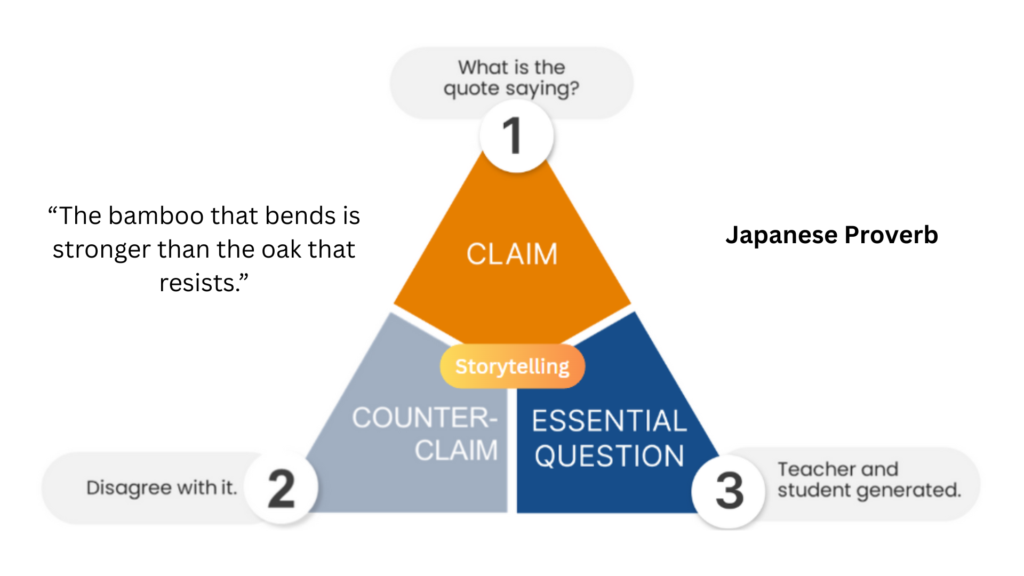
The Teach Different Method™. Claim, Counter-Claim, Essential Question, and Storytelling. The four moves of every structured classroom conversation.
A short, well-chosen quote brings an outside idea into the room. Because it belongs to no one, everyone can examine it together. It creates a safe starting point for disagreement and gives every voice something to engage with. The goal is simple: understand what someone else is trying to say.
A second idea challenges the first, not to win, but to deepen the conversation. When two serious perspectives sit side by side and neither is clearly right, the room cannot settle for easy agreement. That tension prevents groupthink and invites deeper critical thinking.
The Essential Question emerges from the tension between the Claim and Counter-Claim. It helps the room explore the contradiction and identify what is really at stake. Whether created in advance or during the discussion, it gives the disagreement a meaningful direction.
Storytelling brings the thinking to life. Students connect the question to their own experiences and share those experiences as evidence. Their reasoning is grounded in real life, and the class becomes a community that learns about and from one another.
Philosophy named the craft. Neuroscience explained the need. A Chicago classroom proved it works. Three independent lines of evidence pointing at the same thing.
The four moves weren’t invented in 2017. They were named in 2017. The thing itself is much older.
In Book Four of the Republic, Plato argues that nothing can be both itself and its opposite in the same respect at the same time. He uses this principle to prove the soul has parts. The experience of being torn between two true-feeling things is what tells us we are more than one thing. A Claim and a Counter-Claim, set honestly against each other, are this principle in working form. The Method does not ask students to resolve the contradiction. It asks them to stay inside it long enough to find out what it is showing them.
In Book Seven, Plato describes the moment thought wakes up. Some perceptions, he says, do not summon thinking at all. A finger is just a finger. But hold up three fingers and look at the middle one. It is both larger (than the small) and smaller (than the large) at once. The senses cannot settle the question. So the soul has to call on intellect. Plato says this kind of contradiction is what makes philosophers of us. The Essential Question is the version of that moment a teacher can build on purpose. It is the catalyst. Not the conclusion.
After Plato · Republic, Book VII
The Teach Different Method™ is, in this older sense, a techne. Practiced once, it teaches a lesson. Practiced as a routine, it builds a classroom. Practiced as a discipline across years, it builds the muscles a generation needs to leave the cave of unexamined assumption and think for itself, out loud, together.
Structured conversation isn’t just a method. It is a neurological need.
For years, brain science has explored neural coupling, a powerful event where human brain activity syncs during live conversations. This phenomenon isn’t just about talking and listening. Great conversations actually foster empathy, bring out emotions, and trigger hormones that evoke feelings of belonging and trust.
We know it works because it kept working. Eight years. Hundreds of teachers. A $250,000 state grant.
The Teach Different Method has reached educators and students across the globe, building structured conversation into classrooms on every inhabited continent.
The Teach Different Method™ is the craft. The certificate program is how teachers learn to run it. Together they’re the engine of a daily practice that’s building, slowly, classroom by classroom.
Team Human, one structured conversation at a time.