
Strategic Plan · FY 2026 to FY 2030

Teach Different Method Training
Statewide Expansion

Better Conversations. Better Teachers. Healthier Students.

2,600+

Teachers Trained

Since 2017

Eight Years of Practice

40,000+

Students Reached

5

Continents

Better Conversations. Better Teachers. Healthier Students.

Contents

Table of Contents

Strategic Plan
Addenda

Better Conversations. Better Teachers. Healthier Students.

Illinois students are in crisis. Anxiety, depression, and disengagement are rising in every county, every district, every demographic. Over 60% of college students nationally report mental health challenges, a nearly 50% increase since 2013.[7] The pipeline starts earlier than college. The recommended school counselor-to-student ratio is 1:250; Illinois districts most in need operate at 1:500 or higher.[2] Beginning in fall 2027, Public Act 104-0032 requires every Illinois school to conduct universal student mental health screenings.[1] When those results come in, the system will need an answer.

Most districts don’t have one.

The Teach Different Method Training (TDMT) program is that answer. Built and field-tested through a state mental health grant from the Illinois Department of Human Services, TDMT gives teachers a structured, evidence-based conversation routine that works in any subject, any day. It requires no additional staff. No clinical infrastructure. No schedule disruption. It works because it puts the tool in the hands of the people who are already there: teachers, who spend 80% of the school day with students and are the most consistent, trusted adult presence in their lives.

The program is grounded in SAMHSA’s Six Dimensions of Wellness and the Mental Health Continuum Model, both federal frameworks for preventive behavioral health. It has already trained 80 educators across 23 schools in 13 Illinois counties, reaching more than 4,000 students. The results are documented: 78% of surveyed students reported better understanding of different perspectives. 65% reported feeling safe sharing their thoughts in class. 58% reported staying calmer during disagreements.

This is not a pilot. It is a proven foundation.

The Illinois Institute of Independent Colleges and Universities (IIICU), in partnership with Teach Different, presents a five-year plan to expand TDMT from that foundation to a statewide network covering all 38 Regional Offices of Education. That means 3,600 trained educators and an estimated 400,000 Illinois students reached annually by Year 5.

The cost: ~$8.2 million over five years, approximately $31 per student per year at full deployment.

Illinois Institute of Independent Colleges and Universities

The Illinois Institute of Independent Colleges and Universities (IIICU) is a 501(c)(3) organization established in 1982 to strengthen private higher education in Illinois through research, fundraising, and collaborative programming. Over more than four decades, the Institute has been a trusted steward of federal and state investments in education, workforce development, and community health. IIICU’s track record includes nearly $900,000 in federal funding, including a $600,000 U.S. Department of Education award for Project Connect and $294,500 in U.S. Small Business Administration funding directed to the Institute by Congress. Its initiatives have consistently served K-12 educators, college students, and communities across the state, demonstrating both fiscal responsibility and programmatic integrity.
IIICU was reconstituted in 2024 under new leadership, with a focused mandate to serve as the institutional home for youth mental health and educator training initiatives in Illinois. Its first and founding program partnership is with Teach Different, supporting the Teach Different Method Training (TDMT) statewide expansion. The partnership’s first expression was a $250,000 Illinois Department of Human Services appropriation. Teach Different served as program operator on that grant, training 80 educators across 23 schools and reaching more than 4,000 students. That work is the proven foundation on which this five-year plan builds.

About Teach Different

Teach Different was founded by practicing educators in 2017, in response to the traumatic experience of Jarvis, a high school sophomore on the west side of Chicago. What started as a really bad class became, the next day, a really good conversation about revenge. That conversation changed the room. It became an obsession to use short quotes to start discussions about ideas that really matter to young people. Through hundreds of hours of iteration, a worldwide pandemic, and input from educators at every level, the Teach Different Method was born.
Since that first conversation, Teach Different has brought its method to communities ranging from Chicago’s North Shore to rural downstate Illinois, demonstrating its adaptability across demographic, economic, and geographic contexts. The SAMHSA Six Dimensions of Wellness and the Mental Health Continuum Model provide the clinical and programmatic foundation that state and federal funders require. But the heart of the method has never changed. A structured conversation, in the right hands, produces compassion, understanding, and a collective sense of belonging. That is the soil in which academic learning grows. And it is the most powerful thing a teacher can give a student who has never felt heard.

Governance, Transparency, and Conflict of Interest

IIICU and Teach Different maintain a formal fiscal sponsorship relationship in which IIICU serves as the fiduciary and institutional lead for the public and philanthropic funding supporting the Teach Different Method Training program, while Teach Different operates the program as a subcontracted service provider. The partnership reflects a longstanding institutional connection. The late Dr. Donald Fouts, father of Teach Different co-founders Steve and Dan Fouts, served as president of IIICU for two decades prior to his passing in 2020.
IIICU’s governance is independent of Teach Different. The Institute maintains its own board, its own financial accounting, and its own compliance infrastructure. The board has adopted documented conflict-of-interest procedures that govern all decisions related to the Teach Different partnership, including board review and approval of subcontract terms, budget modifications, and program evaluation processes. Teach Different’s co-founders recuse from any IIICU board discussions involving the partnership. The full conflict-of-interest policy and related governance documentation are available to funders and oversight bodies upon request.

IIICU's Role in the Partnership

IIICU serves as fiscal sponsor and institutional lead for the Teach Different Method Training program. Its specific functions include the following.
Fiscal administration. IIICU receives and administers all public and private non-dilutive funding, including state appropriations, foundation grants, philanthropic donations, casino community grants, and municipal mental health funding. All expenditures from these sources are managed through IIICU’s accounting infrastructure and subject to standard nonprofit financial controls.
Compliance and reporting. IIICU maintains the grant compliance documentation, financial reporting, and funder accountability required by state and federal grant administration rules, including Uniform Grant Guidance (2 CFR 200) requirements where applicable. This includes periodic financial and programmatic reports to all funders.
Board oversight of the partnership. IIICU’s board reviews and approves all subcontract terms, budget modifications, and major program decisions, independent of Teach Different’s co-founders, who recuse from these deliberations.
Independent program evaluation. IIICU holds the contract with the program’s independent evaluator, who is drawn from IIICU’s network of member institutions and is responsible for outcome data collection, analysis, and annual funder reporting. This structure ensures that program outcomes are evaluated by a party institutionally separate from Teach Different.
Accreditation and professional development authority. IIICU is an approved professional development provider under the State of Illinois and issues Continuing Professional Development Units (CPDUs) to Illinois educators who complete Teach Different certification programs. This accreditation is held by IIICU as a nonprofit educational institution and enables Teach Different program participants to apply their certification toward Illinois teacher recertification requirements.
Institutional representation. IIICU serves as the public institutional sponsor of the program in funder communications, legislative engagement, and philanthropic outreach, providing the 501(c)(3) credibility required to engage with funders whose capital is restricted to nonprofit recipients.
Teach Different serves as the program operator under a formal subcontract with IIICU. Teach Different’s responsibilities include curriculum development, educator training, certification cohort delivery, platform operations, content production, and all direct engagement with participating educators, schools, and communities. Teach Different retains ownership of all intellectual property, curriculum, platform assets, outcome data, and commercial products. Commercial revenue generated by Teach Different through direct sales to schools and homeschool families is earned independently by Teach Different and does not flow through IIICU.

Illinois Democracy Schools Network

The Teach Different Method Training program’s early growth was significantly shaped by its partnership with the Illinois Democracy Schools Network (IDSN), a statewide initiative spanning approximately 100 schools committed to civic education and democratic classroom practices. IDSN schools provided an ideal early-adoption environment. Their educators were already oriented toward inquiry-based, discussion-driven pedagogy, making them natural candidates for TDMT certification. This partnership produced the program’s first cohort of fully certified educators and showed early that TDMT could scale across diverse school communities. The Democracy Schools network continues to serve as a primary pipeline for early adopters as TDMT expands to new regions, and its alignment with TDMT’s mission makes it a natural and enduring partner in the program’s statewide growth strategy.
Walk into any school in Illinois and you will see it. A student sitting alone, head down, earbuds in, scrolling. Not in trouble. Not acting out. Just gone. Absorbed into a device that asks nothing of them and gives back nothing real. Multiply that student by thousands and you are looking at a generation that is struggling in ways no previous generation has.
This is not anyone’s fault. It is a condition.
Young people today are growing up inside algorithms designed to hold attention, not build connection. They are exposed to content that normalizes violence, rewards outrage, and blocks empathy. They spend hours in digital environments engineered to keep them isolated while feeling connected. And the result is a generation with fewer opportunities to practice the skills that keep us human. Things like looking someone in the eye, listening to a perspective they disagree with, and staying in a conversation when it gets uncomfortable.

The problem is not that young people lack character. The problem is that they lack environments where pro-social behavior is practiced, expected, and safe.

The Scale of the Problem

What Is Missing

The gap is not clinical. It is foundational. Schools do not need more referral systems. They need classrooms where connection, belonging, and trust are built into the daily experience, where every student is seen, not just the ones in crisis.
Teachers spend 80% of the school day with students. They are the most present, most consistent adult relationship in a young person’s life. If there is a natural, sustainable way to wrap support around every student — before, during, and after the screenings — it runs through them.

"Teachers are increasingly expected to serve as the frontline of student mental health, yet they have no training in how to do it. TDMT changes that — before the 2027 mandate arrives."

TDMT gives teachers a structured, evidence-based conversation routine they can use in any subject, any day. It builds the pro-social behaviors and core SEL skills that the problem section describes: empathy, emotional regulation, perspective-taking — not through a separate program bolted onto the school day, but through the classroom itself. It requires no additional staff, no clinical infrastructure, and no schedule disruption. Grounded in SAMHSA’s Six Dimensions of Wellness and the Mental Health Continuum Model, both federal frameworks for preventive behavioral health, it works as a standalone strategy and as a complement to existing counseling and mental health services.
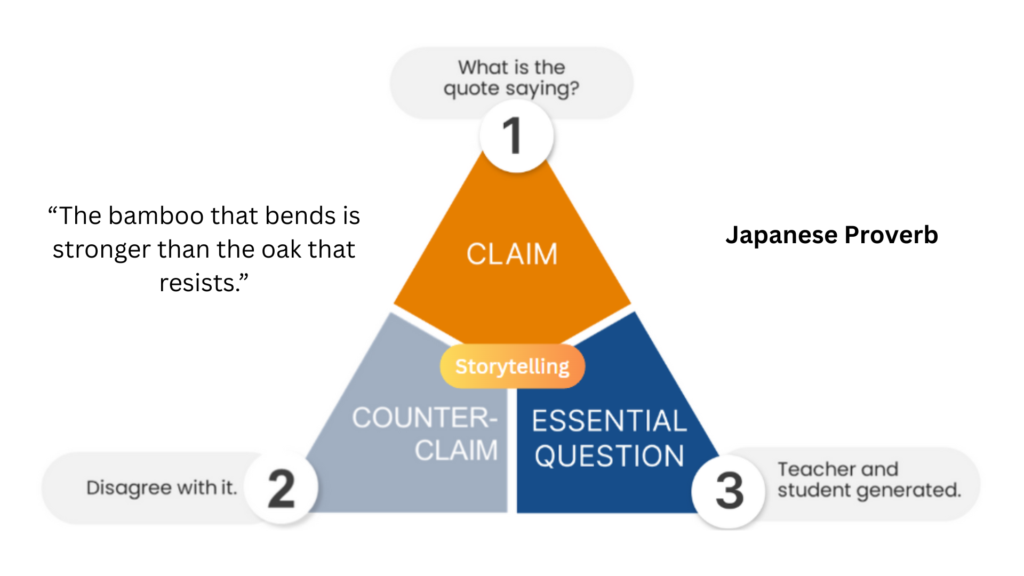
The Teach Different Method conversation structure

How the Program Works

Teachers enter the program through Regional Offices of Education, school districts, and partner networks including the Illinois Democracy Schools Network. Recruitment reaches educators through department chairs, curriculum directors, and building principals, and through Teach Different’s presence at ROE conferences, statewide association events, and cohort training convenings held throughout the year across Illinois.
Educators who complete training receive a certificate of participation and join the Teach Different Professional Learning Community, an online platform for ongoing resources, statewide practitioner connections, and continued development. Full certification requires more: documented use of the method in their own classrooms, a structured reflection process, and coaching from a Teach Different mentor. Certified educators receive 15 Continuing Professional Development Units (CPDUs) issued by the Illinois Institute, accredited by the State Board of Education.
Certified educators become the program’s mentors and its most credible advocates. Teachers teaching teachers, supporting each other in mastering the art and science of classroom conversation. That community is what makes the program self-sustaining long after the initial training ends.
As certified educators demonstrate the method in their buildings, some districts expand participation beyond the subsidized cohort, purchasing additional certifications and platform access directly through Teach Different. This organic conversion from publicly funded adoption to district-sustained investment is how the program outlasts the grant period.

What the Evidence Shows

The 2025–2026 IDHS-funded pilot trained 80 educators and certified 43 across 23 schools in 13 Illinois counties, achieving a 54% certification rate. The program collected 985 student surveys across more than 4,000 students reached.

78%

Better understood different perspectives

74%

Look at ideas in different ways

65%

Felt safe sharing thoughts in class

58%

Kept interested in class and school

58%

Stayed calmer during disagreements

53%

Better able to work through disagreements

Source: 985 student surveys collected across 2025–2026 IDHS-funded cohorts · Fall Pilot II Impact Report

In Their Own Words

"Since Covid, I felt like I was kind of losing my fastball as far as getting kids to be engaged and participate. But this program sparked a strategy in class — getting kids to talk, getting kids to be engaged."

Mr. Florczyak · Social Studies · Freeburg Community High School

"I felt like going through the program, I had so many moments where I heard kids speak that almost are never willing to volunteer."

Mrs. Massing · Social Studies · Grayslake Central High School

"I did have a kid who would rather not be in class at all, and during that discussion he's like, 'I'm having so much fun, I don't want to leave.'"

Ms. Michaud · Social Studies · Winnebago Middle School

"Students who were not engaged with what I normally do liked this — they liked the structure."

Ms. Baxter · ESL · West Community High School, Forest Park

Students, in their own words

What It Costs and Why That Matters

~$31 per student per year

Five-year average, fully loaded cost across subsidized cohorts.[12]

How Student Reach Is Calculated

Student reach figures are based on 50 students per trained educator per year and 100 students per certified educator per year, reflecting a single teacher’s active classroom load. Every trained and certified educator remains active in subsequent years, reaching a new cohort of students each year. Annual reach figures reflect all cumulative active teachers across the full ecosystem, not just new entrants, producing a growing annual impact as the educator base compounds.

The full ecosystem includes both the subsidized cohort and Teach Different’s commercial track. Combined, they reach an estimated ~400,000 students annually by Year 5. Full methodology is detailed in Section IX and the Budget Addendum.

Illinois schools are required to conduct universal student mental health screenings beginning fall 2027. That is Year 2 of this plan. When those results come in, districts across all 38 Regional Offices of Education will face the same reality at the same time: documented student need and no classroom-level response infrastructure in place. The value of TDMT is different depending on where a district is in that timeline, but it is real at every point.

Districts that train educators before the mandate arrives will be prepared. They will have teachers who already know how to build belonging, manage difficult conversations, and support students showing early signs of distress, before the screening data confirms what those teachers already see every day. Districts that come in during or after the mandate will have documented need and an evidence-based response they can deploy immediately, without hiring clinical staff or restructuring their schedules.[3]

This plan expands to reach all 38 ROEs by following relationships, funding, and superintendent readiness rather than a fixed rollout sequence. Each trained educator becomes a credible local voice. Each certified educator becomes a resource colleagues can see working in real classrooms. Coverage builds through results. Years 4 and 5 shift from coverage to depth: more educators trained per region, certified educators serving as peer mentors, and districts sustaining the program through their own budgets.

Coverage Milestones

The tables below show where the money goes, where it comes from, and what it produces. The first table breaks down projected expenditures by budget category across all five years. The second shows how those costs are funded and what the investment delivers.
IIICU personnel includes the Project Director, Program Coordinator, Administrative Assistant, and Communications & Digital Systems Coordinator (4.0 FTE), with 3% annual cost-of-living escalation. The Teach Different subcontract funds all program delivery staff, including Lead Trainers & Regional Training Staff, Workshop Facilitators, Content Developer, Community Manager, AI Specialist, Tech Support, platform infrastructure, and Certified Educator Mentor Stipends. Indirect costs calculated at 10% of direct costs excluding the Teach Different subcontract and Participant Support Costs. Full budget detail and methodology notes are available in the Budget Addendum.
The following table shows how those costs are funded and what the investment produces.
Note: Year 1 public/private investment approximately matches Year 1 program cost, with a thin working margin sustained primarily through accelerated State & Legislative engagement following the non-award of the federal CDS request. “Students Reached Annually” reflects the total number of students reached in that year by all active trained and certified educators in the full ecosystem. It is an annual snapshot, not a cumulative sum, and grows each year as more educators enter the program. Detailed budget notes are available in the Budget Addendum.
Every funder considering support for this initiative does so in the context of a ~$8.2 million, five-year commitment already in motion. Their investment is one part of a multi-source, multi-year initiative that has already secured $465,000 in confirmed investment and built the programmatic track record to support a compelling case at every level of the funding ecosystem: state, philanthropic, municipal, corporate, and local. Approximately $6.78 million in public and private investment is identified across seven distinct funding tracks, with an additional $1.44 million in projected commercial revenue, for a total program investment of ~$8.2 million.

Program Continuity: Not Contingent on Any Single Award

All five years are supported by a lean, mission-focused team whose composition evolves modestly as the program scales. Every position is essential; none are redundant. The team operates across two employers: IIICU employs the institutional spine — program leadership, administration, compliance, and communications — while Teach Different employs all program delivery staff through the subcontract. Together, these roles constitute the minimum viable team for a program operating at statewide geographic scale across 38 regional offices of education.

IIICU-Employed Staff

Teach Different Subcontract · Program Delivery Staff

Program evaluation is structured around three tiers of evidence, each designed to demonstrate impact at a different level of scale and rigor.

Tier 1: Student Outcome Surveys. Every training cohort includes a structured student survey administered in classrooms where trained educators implement the Teach Different Method. The survey instrument has already been validated through the program’s initial IDHS-funded cohorts, where 985 student surveys were collected across 80 trained educators and more than 4,000 students. Documented outcomes include: 78% of students reported better understanding of different perspectives; 74% reported looking at ideas in different ways; 65% reported feeling safe sharing thoughts in class; 58% reported staying calmer during disagreements; 58% reported sustained interest in class and school; and 53% reported improved ability to work through disagreements. These survey results constitute the program’s baseline outcome data. As the program scales, the independent evaluator will administer the same instrument across all new cohorts each year, building a longitudinal dataset that tracks whether outcomes hold, improve, or vary across regions, grade levels, and school demographics.

Tier 2: Educator Implementation and Certification Metrics. The evaluator tracks cohort completion rates, certification conversion rates, PLC engagement levels, and educator self-reported implementation frequency. These metrics measure whether the training translates into sustained classroom practice, the mechanism through which student outcomes are produced. Certification conversion rate, in particular, serves as a proxy for depth of adoption: educators who pursue certification have committed to integrating the method into their ongoing practice, not simply attending a workshop.

Tier 3: School-Level Case Studies. Beginning in Year 2, the evaluator will partner with a small number of participating schools to conduct longitudinal case studies measuring the method’s impact on institutional metrics that matter to administrators and policymakers: student attendance, tardiness, disciplinary referrals, and classroom engagement indicators. These are the metrics tied to school funding formulas, accreditation standards, and district accountability reporting. The case studies are designed to produce the kind of evidence that moves a superintendent from awareness to adoption. Not survey data about how students feel, but institutional data about how schools perform. If the method demonstrably reduces absenteeism or disciplinary incidents in case study schools, that finding becomes one of the most powerful tools in the program’s expansion strategy.

The independent evaluator produces an annual outcomes report synthesizing data across all three tiers, which is provided to IIICU, funders, and oversight bodies. The evaluation framework is designed to be cumulative: each year’s data strengthens the evidence base, and the case study findings, expected to begin producing results in Year 3 — are intended to shift the program’s evidence profile from promising to proven

The long-term sustainability of TDMT rests on two parallel tracks. The first is the IIICU-administered public and private investment described throughout this plan: grants, appropriations, philanthropy, and community investment that funds the training program, the PLC infrastructure, and the statewide expansion through Year 5. The second is Teach Different’s commercial revenue, which grows directly from the success of the first track: as subsidized cohort educators bring the method into their schools, an estimated 8% of those schools convert to full commercial participants. Each converting school purchases a bundled package that includes PLC subscriptions and additional certifications. Teach Different funds its own business development staff from commercial revenue, not from IIICU program funds, ensuring full compliance with federal and state restrictions on the use of grant funds for fundraising costs.

Commercial revenue grows each year as the subsidized educator base expands. By Year 5, an estimated 288 schools will have converted, generating $360,000 in annual commercial revenue and sustaining the program well beyond the conclusion of public investment. The program does not end when the grant ends. It continues because trained educators carry the method forward throughout their careers, and because the institutions they work in have already seen it work. School conversions also generate recurring annual revenue as PLC subscriptions renew, a compounding sustainability dynamic that is not reflected in these conservative projections but that strengthens the long-term commercial foundation with each passing year.

Each school conversion = 10 PLC subscriptions × $250 + 2 certifications × $1,250 = $5,000. Conversion rate assumes 8% of subsidized cohort trained educators convert their school. See student reach methodology in Section IV.
Every statewide initiative operates under uncertainty. The following risks have been identified and addressed in the program’s design. In each case, the mitigation is structural: built into the model, not dependent on a future decision.

Teacher recruitment and participation. Educators are overextended, skeptical of new initiatives, and protective of their limited professional development time. The $100 participant stipend and $50 implementation materials allocation reduce the personal cost of participation, but the primary recruitment mitigation is relational, not financial. Teachers enter the program through Regional Offices of Education, the Illinois Democracy Schools Network, building principals, and colleagues who have already completed the training. Every cohort produces educators who become credible advocates within their own buildings. The program’s validated impact data, including teacher testimonials describing renewed engagement after years of post-COVID burnout — reinforces that credibility. Recruitment risk declines each year as the trained educator base grows and word of mouth compounds.

Funding timing and sequencing. The program’s diversified funding model ensures that no single source represents more than 30% of any given year’s budget. Year 1 is fully funded from secured and committed sources. If any individual grant, appropriation, or philanthropic commitment arrives late or falls short, the program adjusts its pace of expansion, adding fewer new cohorts in the affected year and shifting volume into subsequent years. The five-year target, the geographic strategy, and the declining cost-per-educator trajectory do not change. The ramp adjusts. The destination does not.

Platform build timeline and cost. Custom software projects carry inherent risk of delays and cost overruns. The program mitigates this in three ways. First, Years 1 and 2 on Mighty Networks give the team two full years of operational data and user feedback to define platform requirements before the build begins, eliminating the most common source of software project failure: building before the problem is understood. Second, advances in AI-assisted software development have materially reduced both the timeline and cost of purpose-built platforms of this scope. Third, if the custom build runs long, Mighty Networks continues operating without interruption. There is no service gap during the transition.

District adoption slower than projected. The commercial conversion rate is estimated at 8% of subsidized cohort schools. If actual conversion comes in lower, Teach Different’s commercial revenue grows more slowly, but the subsidized program is unaffected. The two tracks, public investment and commercial revenue — are financially independent by design. Grant-funded training, certification, and PLC operations do not depend on commercial performance. The 8% estimate is itself conservative; it reflects only organic conversion from trained educators advocating within their own buildings, not active sales outreach.

Staff turnover in a lean team. The program operates with a small, mission-focused team. Losing a key staff member, particularly the Project Director or a Lead Trainer — would create operational disruption. The mitigation is threefold: the certification pipeline continuously produces experienced educators who can step into training and facilitation roles; the PLC platform preserves institutional knowledge, training protocols, and cohort records independent of any individual; and the partnership between IIICU and Teach Different distributes organizational knowledge across two institutions rather than concentrating it in one.

"Better Conversations. Better Teachers. Healthier Students."

Illinois is at an inflection point. The student mental health screening mandate of fall 2027 is not a distant policy abstraction. It is an approaching moment of reckoning. When those screenings are completed, Illinois schools will face documented evidence of student mental health need at a scale most are not prepared to address. The question for policymakers, philanthropists, and community leaders is not whether that moment is coming. It is whether Illinois schools will be ready to meet it.
The Teach Different Method Training initiative is the answer. An evidence-based, classroom-based Tier 1 prevention model. A declining cost structure that rewards investment and scale. A statewide infrastructure that will not disappear when a funding cycle ends. And a human record: teachers who speak differently, students who belong, and communities that are stronger. That record makes the case better than any spreadsheet.
The numbers are compelling: 3,600+ trained educators. 400,000+ students reached annually by Year 5. All 38 Regional Offices of Education covered. A statewide Professional Learning Community sustained by Teach Different’s growing district subscription revenue. And a partnership with the Illinois Democracy Schools Network, already present in nearly 100 schools statewide, that provides the trust, the relationships, and the early-adoption pipeline that makes every new regional expansion faster and more credible.

The Illinois Institute of Independent Colleges and Universities and Teach Different invite every partner who shares our belief that every Illinois student deserves a teacher who knows how to reach them to join us in making that belief a statewide, permanent reality.

This program has already begun. It began with a $250,000 state investment and 80 trained educators who changed the way students experience their classrooms. It continues now, on committed funding, building toward the infrastructure that makes statewide impact inevitable. What partners are being asked to do is not to start something. It is to accelerate something that will not stop.
Dr. Frank Houston, President
Illinois Institute of Independent Colleges and Universities
1123 South Second Street, Springfield, IL 62704
[email protected]  ·  (217) 299-6048

Dan Fouts

Teach Different
22 Fox Mill Lane, Springfield, IL

“Supporting Illinois Students.
Empowering Illinois Teachers.
Strengthening Illinois Communities.”

Addendum A: Clinical and Programmatic Foundation

Why TDMT Works: Evidence, Framework, and Policy Context

SAMHSA Alignment · Mental Health Continuum · Tier 1 Strategy · Illinois Public Act 104-0032

Purpose: This addendum documents the clinical and programmatic basis for the Teach Different Method Training program. It is intended for program officers, state agency reviewers, and school administrators who want to understand how TDMT connects to established mental health frameworks, what Tier 1 prevention means in a school context, and why Illinois's new universal mental health screening law makes a classroom-based conversation routine more urgent, not less, than ever before.

I. What the Teach Different Method Is

The Teach Different Method is a structured classroom conversation routine that any teacher can learn and use, in any subject, at any grade level, without clinical training or additional staff. It gives teachers a repeatable framework for facilitating discussions that build critical thinking, perspective-taking, storytelling, and the kind of respectful dialogue that students practice but rarely experience in a formal classroom setting.
A teacher can use the method at the opening of a lesson to activate prior knowledge and build curiosity. They can use it at the close of a unit to consolidate learning and surface questions. And they can use it for standalone discussions on non-academic topics (ethics, current events, personal experience, community questions — that give students the opportunity to develop social and emotional skills in a structured, low-stakes environment.
The result is a classroom that feels different. Students who rarely speak begin to participate. Students who struggle to listen begin to engage. The connection between a student and their teacher, and between students and each other — deepens through the repeated practice of being heard and taking others seriously. That connection is not incidental to student mental health. It is foundational to it.

II. Alignment to SAMHSA's Six Dimensions of Wellness

The Substance Abuse and Mental Health Services Administration (SAMHSA) is the primary federal agency responsible for advancing behavioral health in the United States. SAMHSA’s Six Dimensions of Wellness framework is one of the most widely recognized models for defining and promoting holistic mental health, particularly in school and community settings. Alignment to this framework signals that a program is grounded in federally recognized standards, not proprietary theory.
The Teach Different Method maps directly to five of the six dimensions and supports the sixth indirectly. The alignment below describes how specific features of the conversation framework fulfill each dimension.

Emotional Wellness

The ability to cope with life’s challenges and express feelings constructively

Primary

The Teach Different Method maps directly to five of the six dimensions and supports the sixth indirectly. The alignment below describes how specific features of the conversation framework fulfill each dimension.

Social Wellness

The ability to develop healthy relationships and a sense of belonging

Primary

Structured classroom conversation is, at its core, a socialization practice. TDMT creates repeated, low-stakes opportunities for students to listen, respond, disagree respectfully, and discover common ground with peers they might never otherwise engage. The belonging that results — the feeling of being heard in a room full of people — is among the most protective factors known to reduce adolescent mental health risk.

Intellectual Wellness

The ability to engage in critical thinking, creativity, and lifelong learning

Primary

Critical thinking and questioning are explicit structural features of the Teach Different Method — not side effects. Every conversation is designed to surface multiple perspectives, challenge assumptions, and invite students to construct and defend their own reasoning. This is intellectual wellness in its most practical form: the habit of thinking carefully before speaking and listening carefully before concluding.

Spiritual Wellness

A sense of purpose, meaning, and connection to something larger than oneself

Secondary

TDMT’s use of storytelling and exploration of profound, non-academic ideas gives students recurring opportunities to connect their personal experience to larger questions of meaning, identity, and community. While the method does not address spirituality directly, the depth of discussion it enables — and the sense of purpose students develop when their voice matters in a classroom — supports the dimension of spiritual wellness through the lived experience of significance and connection.

Occupational Wellness

The ability to find personal satisfaction and meaning in one’s work or role

Secondary

For students, the “occupation” is school. A student who feels heard, engaged, and intellectually respected in their classroom experiences their school role as meaningful — a foundational condition for academic engagement and long-term motivation. For teachers, the method restores professional satisfaction by giving them a tool that visibly changes how students show up. Both outcomes represent occupational wellness in the school context.

Physical Wellness

The ability to maintain a healthy body through physical activity, nutrition, and rest

Indirect

TDMT does not address physical wellness directly. However, the research literature is clear that emotional regulation, social connection, and sense of belonging — all of which TDMT builds — are strongly correlated with physical health outcomes including sleep quality, stress-related illness, and substance use. The physical wellness dimension is supported indirectly through the program’s primary emotional and social outcomes.

III. The Mental Health Continuum Model

SAMHSA’s Mental Health Continuum Model describes mental health not as a binary condition. It exists as a spectrum ranging from thriving to crisis. At one end are students who are thriving: they feel connected, capable, and resilient. At the other end are students in crisis: they are experiencing acute mental health episodes that require clinical intervention. In between is a large and often invisible population of students who are struggling — not yet in crisis, but losing ground.
The most important insight of the continuum model is that movement along the spectrum is not random. It is shaped by protective factors — the conditions in a young person’s environment that build resilience and prevent deterioration. Connection to a trusted adult. A sense of belonging in a community. The experience of being heard. The capacity to articulate and process difficult emotions. These are not clinical interventions. They are human experiences — and they happen, or fail to happen, in classrooms every day.
The Teach Different Method operates at the healthy end of the continuum. It is not a response to struggle or crisis. It is the daily practice of building the protective factors that make struggle and crisis less likely. A classroom where students feel heard, connected, and capable of engaging with difficult ideas is a classroom where fewer students drift toward the struggling end of the spectrum.

The Teach Different Method Across the Continuum

Before Identification

The daily conversation routine builds belonging, trust, and emotional vocabulary. Students who are struggling are more likely to be seen — and more likely to speak — in a classroom where their voice has always mattered. The teacher, practicing structured conversation, develops the attunement to notice when a student goes quiet.

During Crisis

A teacher trained in structured conversation has a tool for navigating difficult classroom moments — not as a clinician, but as a skilled human presence. The method gives teachers the language and the frame to hold space for a student in distress without needing to resolve the crisis themselves, and to keep the classroom a place of safety while clinical support is arranged.

After Identification

The classroom remains a place of normalcy and human connection while clinical interventions happen elsewhere. Students returning from crisis — or navigating a formal mental health process — re-enter a room where structured conversation is routine, connection is practiced, and resilience is built through the daily experience of being part of a community that thinks and talks together.

IV. Illinois Public Act 104-0032: The Policy Context

On July 31, 2025, Governor JB Pritzker signed Senate Bill 1560 into law as Public Act 104-0032, making Illinois the first state in the nation to require universal student mental health screenings. Under the law, all Illinois school districts must offer annual mental health screenings to students in grades 3 through 12 beginning the 2027–2028 school year. The Illinois State Board of Education is required to provide model procedures and resource materials to districts by September 1, 2026. The state will provide free access to screening tools and associated technology.
The law is a historic step forward. It also creates an urgent and largely unaddressed problem: what happens after a student is identified?
Screening is identification, not intervention. When Illinois schools complete their first round of universal screenings in fall 2027, they will have documented evidence of student mental health need at a scale most are not prepared to address. Counselors are already stretched beyond capacity. Clinical services are scarce in rural and high-poverty communities. And the students who screen as struggling will still be in classrooms every day, with teachers who have no systematic tool for supporting their wellbeing in the normal course of instruction.
The Teach Different Method Training program is not a clinical response to screening results. It does not need to be. What it provides is something more fundamental: a classroom environment built on connection, belonging, and the daily practice of being heard. That environment is what makes screening results less alarming, what supports students while clinical interventions are arranged, and what builds the resilience that helps students move forward after those interventions conclude. TDMT is not what comes after the screening. It is what makes the screening less necessary — and what makes it more survivable when the results are hard.

V. Understanding Tier 1: Universal Prevention in Schools

Schools organize their student support systems using a three-tier model. Understanding where TDMT fits, and why it matters that it fits at Tier 1, requires a plain-language explanation of what the tiers mean in practice.

Tier 1

Universal Prevention

For every student, every day

Tier 1 strategies reach all students regardless of any designation, diagnosis, or identified need. No student is singled out. No referral is required. Tier 1 is the foundation — the daily environment in which students learn, connect, and develop the skills they need to navigate life.
Effective Tier 1 strategies are preventive by design. They don’t wait for a student to struggle — they build the protective factors that make struggling less likely in the first place.

Tier 2

Targeted Support

For students showing early signs
Tier 2 strategies are for students who have been identified as at risk — students whose behavior, academic performance, or self-reported wellbeing signals that they need more support than Tier 1 alone provides. These are small-group interventions, check-in/check-out systems, and targeted counseling.
Tier 2 requires identification, staffing, and scheduling. It is more resource-intensive than Tier 1 and serves a smaller population — but it depends on a strong Tier 1 foundation to avoid being overwhelmed by volume.

Tier 3

Intensive Intervention

For students in acute need
Tier 3 is where schools spend the most and serve the fewest. It involves individualized clinical intervention, special education designations, crisis response, and intensive wraparound services. These are students whose needs have escalated beyond what Tier 1 or Tier 2 can address.
Tier 3 is expensive in time, money, and staff capacity. Its costs grow when Tier 1 is weak. Every student who escalates to Tier 3 without a strong Tier 1 foundation represents a preventable cost to the school and an avoidable harm to the student.

The Critical Insight

VI. Why TDMT Qualifies as a Tier 1 Strategy

Not every program that claims to support student wellbeing qualifies as a genuine Tier 1 strategy. A true Tier 1 strategy must be universal, proactive, and deliverable within the normal structure of the school day without requiring clinical infrastructure or special designation. TDMT meets every criterion.