
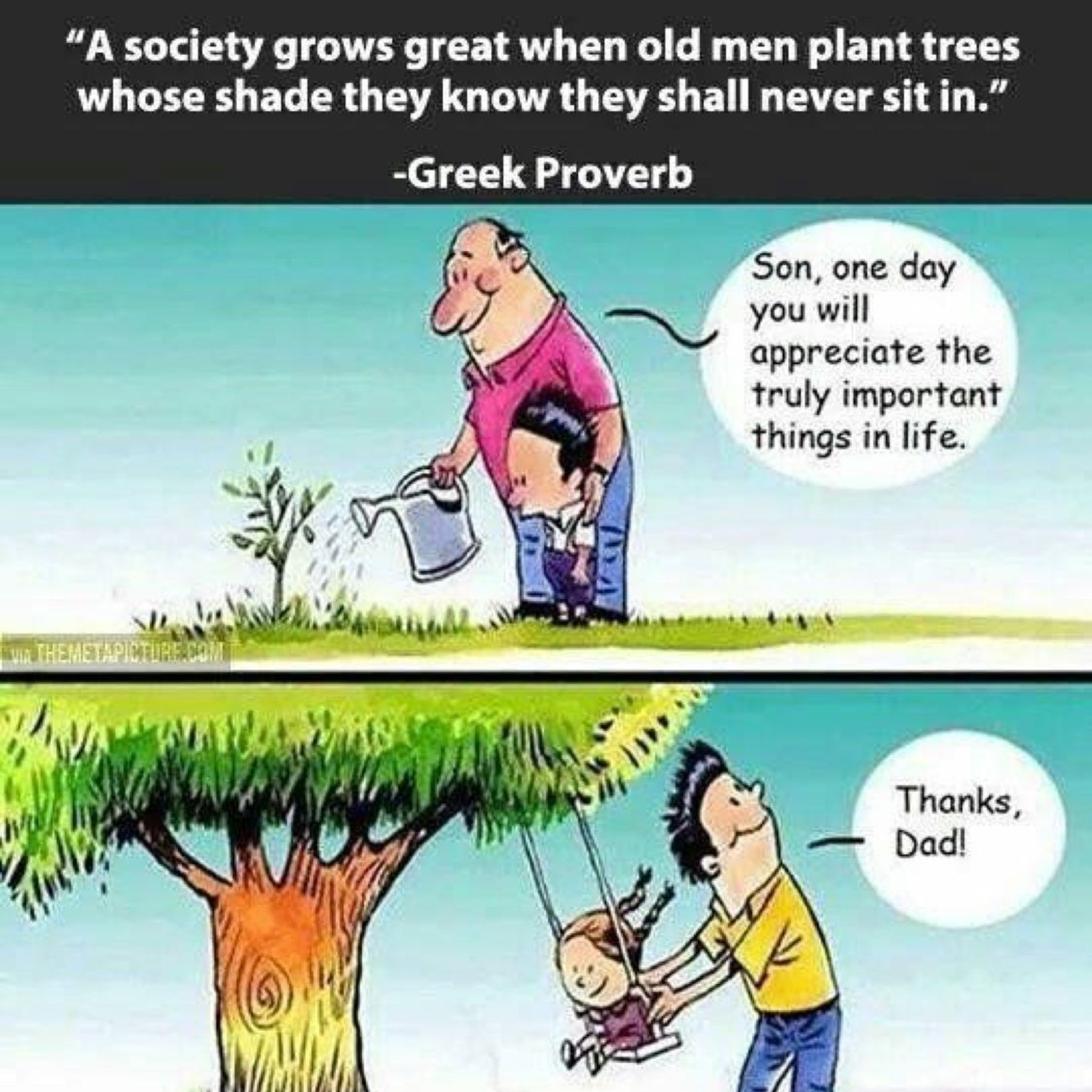
“A society grows great when old men plant trees whose shade they know they shall never sit in.” – Teach Different with a Greek Proverb
This episode explores the concept of societal greatness through the lens of sacrifice, altruism, and civic responsibility. Using a Greek proverb “A society grows great when old men plant trees whose shade they know they shall never sit in,” as a starting point, Dan and Steve Fouts debate different perspectives on taxes, community service, and what it means to build a thriving society. They use the Teach Different Method to unpack the claim, counterclaim, and essential questions, unpacking the meaning of societal greatness and sacrifice.
Chapters
00:00 – The Importance of Civil Conversations
00:52 – Taxation: Fairness and Societal Impact
02:58 – Understanding Sacrifice in Society
07:16 – Counterclaims: Individualism vs. Altruism
12:34 – Philanthropy and Wealth Distribution
19:50 – The Role of Duty in Society
25:46 – Sacrifice and the Health of Society
Image source: https://www.flickr.com/photos/ahhhnice/28079169829/
Transcript
Steve (00:00)
Welcome everybody to the Teach Different podcast. This is a podcast for conversations and conversations are needed now more than ever by not only young people, but really adults and anyone who’s trying to have civil conversations and civil interactions so that we don’t continue to become polarized in society. And so this is what this podcast is all about. This is what Teach Different is all about. And we’re going to address a specific, call it like a current event issue, but it’s really been an issue for a long time in society, which is the idea of whether or not taxes are something that are fair and to what extent we should be taxing people or whether we should be relying on other ways for the economy to generate growth so that we’re not taking money that we’re all earning and giving it back to the government. A lot of people don’t trust the government and don’t want pay taxes. And sometimes this becomes a left-right issue where in general, I would say you have the left that are supportive maybe of the government taking taxes and solving societal problems, whereas people on the right are more about keeping them low. But that’s where the conversation can go south, okay, when people talk about it in those prisms. So that’s going to be what we’ll discuss and we’re going to do it by modeling this Teach Different Method, which is going to start with a quote. I’m here with my brother, Dan. We’re both Teach Different Founders and we’re gonna take on this quote, take on this kind of topic or issue. And then hopefully by the time you leave and you hear this, you’re gonna see what it’s like to have a conversation that is gonna play both sides and you can hopefully picture it with someone that you know, where you can use the quote that way as well. I almost wanna take the persona of a conservative, Dan, cause we’re kind of similar on a lot of our beliefs on things. So I’m gonna be a little bit edgy and come from the right, if that makes sense. But…
Dan (02:29)
I think we’ll both come from the right and left.
Steve (02:31)
Well, I mean, if we do this right, that’s what the quote ends up doing. So here we go. Let’s read the quote. I’ll read it a couple of times. This is a Greek proverb and we’ll just start talking about the quote and this is going to soft land us into the topic. Here’s the quote. A society grows great when old men plant trees whose shade they shall never sit in. A society grows great when old men plant trees whose shade they know they shall never sit in. Greek proverb, let’s start with what it means. Dan, away you go. What does this mean?
Dan (03:25)
Sacrifice is the highest human value. A society grows great when old men plant trees. So someone is planting or doing something, knowing that the benefit that’s gonna come from it is not going to be born by the person who’s doing it. Somebody else is gonna be a beneficiary of another person’s action, and then say a society grows, great. So there is a positive affirmation that people sacrificing things for others makes a society great. My opening question is what does great mean? What does great actually mean? But that’s my first take on the claim.
Steve (04:05)
There you go. Yeah, great. A society grows, great. Kind of with you on the definition of great, but I’m going to just go with that thought of a society’s progress, a society’s, you know, to the extent that it gets closer to a just society and a good society. It takes people willing to do the work who are not going to get the benefit from the work. And my first thought is having a family, providing for a family. It’s that same spirit. Although I guess you could argue that with a family, you’re passing down your own DNA and lineage, and you could still kind of think of that as personal. But I see this quote. A society grows great when old men plant trees whose shade they know they shall never sit in. This one feels more agape, is the Greek word. The idea that you do something for humanity or your sentiment is for a brotherhood of all people and it’s less family oriented. But it’s, I guess it’s sacrifice, and it’s like you’re saying, you don’t get the benefit but…
Dan (05:42)
Or, you again, here’s where I would, maybe there is a benefit if you are planting a tree, knowing that you’re providing something for another person, there is a benefit, that feeling of altruism that you get. So I wouldn’t say it’s completely not self-interested, but it’s definitely weighted on you not reaping the direct benefits of something and that society grows great when people do that. Teachers, I’m in a classroom right now. I mean, how many teachers would we have? How many good teachers would we have in society? They have to believe this. They sacrifice a lot of their time for the benefit of others. Nurses and there’s a lot of professions, I think, that have a component of sacrifice in it.
Steve (06:13)
Right. Yeah. And the fact that people want to be altruistic, that’s a sign of a great society just in and of itself. It’s sacrificing yourself or your happiness or your ability to see something flourish that you started, but you’re also getting something from that and you’re motivated to do it. And that’s a beautiful thing. Should we flip to a counterclaim?
Dan (07:16)
Yeah, let’s work the counterclaim and then come back to the claim. I had an idea and lost it.
Steve (07:23)
A society grows great when old men plant trees whose shade they know they shall never sit in. The counterclaim is that there’s different ways to be great. You know, and I can think of other ways to describe greatness in a society. Something like a society is great where everyone feels that they have an opportunity or that they have hope that they can accomplish whatever they set their mind to.
Dan (07:58)
Society is great when they can pursue their self-interest without interference.
Steve (08:05)
Right, the best society is one that doesn’t intrude on an individual’s happiness while they’re alive. Now this is bleeding nicely into the whole tax issue and how some people say, we deserve the money we earn. Paying taxes may be necessary on some level, but minimal. It’s not our responsibility per se, you know, to build trees and have shade for others. It’s our responsibility to take advantage of the opportunities our society gives us for us and our family. I’m just throwing that out. There are people that believe that and you know, it’s valid and this is the counterclaim.
Dan (09:08)
And I guess there’s a lot to unpack there because what are we talking about that the tax money would be going to pay for? If you say it’s roads, then it’s hard to make the self-centered argument that you shouldn’t pay taxes for better roads since you use the roads yourself and the society benefits from better roads. That’s a crude example.
Steve (09:44)
No, you’re right though. You use the roads and so does your family and you can see the roads There’s something that that’s believable about it Okay, but then take tax money that’s going towards safe food stamps or to help people with unemployment You know the people that are in need that get distributed taxpayer money that’s because of their problem that they’re suffering through. And that philosophy of how taxes should be spent, which is basically uplifting someone else or helping them through a rough spot, that’s the one where people diverge on the people’s willingness to have the government do that. So, I mean, I think that we’re identifying maybe a place where people are going to disagree.
Dan (10:48)
Again, I’m thinking another, how about taxes for a library? Even if you don’t use the library, is there value to surrendering money? to pay for a library so that your community has a place to gather, interact with one another, and feel a sense of community. Is that something that’s beneficial to have in a society? And is it worth taxpayer money to support that? Even if you don’t, or maybe the schools are a better example. You’re 70 years old, you don’t have kids going through the school. 60 % of your property taxes are going to fund the high school down the road. You are providing money so that the next generation is educated and is able to get jobs in your community and contribute meaningfully. You know, there’s a sacrifice there. There’s a sacrifice. You’re not benefiting directly, but more indirectly.
Steve (12:00)
Right. And you know, the quote says, a society grows great when old men plant trees whose shade they know they shall never sit in, which presumes that it’s a person that’s sacrificing almost on an individual level. It’s an individual sacrifice. So let me take this slightly different and bring up Andrew Carnegie. who was a philanthropist, one of the early philanthropists, late 19th century. And he ended up making an argument that having people gain a great deal of wealth in society is actually good for all of society because it equips us to be able to plant trees for the next generation. And what did he do? He created the Carnegie Library System when he was an old man. Ironically, a real famous business type person who believed in capitalism might actually agree with a quote like this and be a personification of it.
Dan (13:20)
That’s the essence of the utilitarian argument. That the morality of your action depends on the consequences and the positive happiness you give to the world. The greatest good to the greatest number. So that if you do, I mean, and here’s the other side to this, if you treat workers a certain way in your Carnegie Steel company, and you maybe pay them less than they’re worth, or you treat them less than they’re worth, this is what some people say happened, then… treating them in an unjust way like that justifies itself because one person is amassing wealth who is then giving that wealth away to the rest of the society in the form of libraries and other philanthropic overtures. So is that, does that make Carnegie’s actions morally right? There’s a morality to this here. And that the great society is the utilitarian society like that, where it’s not about necessarily anything other than as long as the greatest good for the greatest number is achieved, how you get there is not as important.
Steve (14:48)
And of course, not everyone’s going to agree with that as the definition of what makes a society great. It’s not the greatest good for the greatest number. It’s providing the opportunity for everyone, perhaps. And this is something a conservative would argue or a free market capitalist. They would say, what society should be worried about is creating equal opportunity. giving everybody a chance to succeed, to that extent, that could be the tree that you plant. But what you do with that opportunity is going to be different for different people. Some people will squander it. They won’t have the work ethic. They won’t play by the system, play by the rules, but they’ll rely on other people for their own kind of wellbeing. And then others will take advantage of it and become very, very successful. Which brings up the question, in a way, I think it’s possible that you could be that old man that is planting the tree, whether you’re someone from the left or the right. You could come to a point in your life where you say, you know what? There is something that I want to leave for some other people that I’m not going to benefit from. But what’s gonna be left, that’s what’s gonna probably look different.
Dan (16:31)
Yeah, but inside what you said, of course, when you consider the, you know, racism and you made a very good free will argument. that I’m providing equal opportunity. That’s my gift to humanity. The opportunity to use your freedom and your free choice to make good decisions and acquire your own happiness and wealth or whatever it is you need. You know, we don’t operate in a bubble though and witt things like racism and poverty and things that hold us back environmentally, it makes it harder for some to achieve that. So leaving that gift of equal opportunity may not result in the things that some people would want it to result in for other factors.
Steve (17:28)
Yeah, you gotta make society just first before that can mean anything.
Dan (17:36)
Exactly. Before what you said could mean anything, the society has to treat each other in a certain way to allow for that kind of gift to blossom to people. I don’t know if that made sense.
Steve (17:48)
Yeah, right. Yeah, it made sense. It made sense. You know, but people get really, they go after each other on the, on this idea of individual responsibility and then the society helping others in society. There’s kind of like a mistrust from the right that it’s being taken advantage of. And when you enable people and you don’t expect more from them, the society is what gets hurt because people started relying on other people. And you can’t have a bunch of people that rely on other people because then all the work is going to be put in by certain people. And then everybody else will be benefiting from it. This is just the way that it’s thought of by some people. back to your point, resources are not allocated fairly. Environments are different for different people. And you at least have to acknowledge that some people have it easier on a lot of different levels than others. So why not think of things like taxes as resources that can be put toward leveling the playing field a little bit, you know? But the minute you say leveling the playing field, you get people saying, that’s socialism, that’s communism, that’s not individualism. But it’s, well, I said, I’m going to take the… the conservative position. you rescue it or you.
Dan (19:33)
No, you’re walking the line. It’s conservative and liberal. I mean, they’re both perspectives, make a lot of sense. know, what duties do we have to our society? Do we have a duty to ourself or do we have a duty to others?
Steve (19:50)
That’s a good essential question.
Dan (19:51)
What is that? Yeah, that’s an essential question from this. What does that look like to say that we have a duty to our larger society? And when we talk about taxes, what should that look like in terms of paying money and resources to the larger society to do a duty? Because, you know, we are incredibly lucky in many ways, many, you know, depending on what situation people have, we’re lucky to have certain things. So paying money into a system that has benefited you is on one level, you know, a duty, it’s a just thing, but then too much of it creates a certain codependency.
Steve (20:39)
And also the acknowledgement that some people don’t feel that love. You know, they don’t, they haven’t gotten that opportunity. They don’t feel benefited by society. They feel that they have always been kind of hampered by it and they’ve had to struggle. I mean, just think of African-Americans and like marginalized communities are not seen on the same level. by lot of people. So they’re always having to do it on their own. Otherwise it isn’t gonna get done and they don’t rely on it at all. They grow, hopefully resilient of it, but. Yeah, but this whole sentiment that giving something back… That’s a human sentiment for sure. You know, and does it make, is that what makes society great? I mean, I’m starting to like warm up to the quote. I like that definition that if everyone in your society gets to a point where they want to plant a tree whose shade they’ll never experience, that’s a good sign because number one, they were successful enough to be able to plant a tree. That’s a good sign. And number two, they were motivated to give back. Those are related to me. If you feel like you’ve been given something, you do give give back because it’s almost natural.
Dan (22:17)
Right, it’s a sign that you’ve been treated in a way by your society that makes you feel valued. And so if you then are giving back in your old age, you’re passing it along, you’re paying it forward, something that a beautiful gesture to you is then transferred as a beautiful gesture to somebody else. That’s a great society. I think if people are living their life and acquiring things and wanting everything for their self interest and they’re hoarding things up until they die. Well, I mean, I don’t know. I don’t know if that’s a sign of the health of a society. As much as it’s a sign that there was a thought that you’re living independently and you’re not interdependent with others. Yeah, this is actually a really deep quote.
Steve (23:15)
Yeah, because you were saying society and I went back to the individual as you were talking. It’s not, it’s the sign of an unhealthy person. If they feel like they can take all these material things with them and they want to hoard stuff. But it’s a sign of a liberated, happy person when they have enough room in their heart to just say, I’m going to work today on this tree and I’m never going to see it.
Dan (23:45)
No, and my point was though, that if you live in a society where that is the expectation, then you will model that behavior as you get older. Okay, I just had a class actually where I model kids giving compliments to each other. I create an environment where at the end of a discussion, we actually complement each other and show our interdependence in how we’re thinking. So, you know, I think a healthy society produces those types of individuals who make those kinds of value choices later in life. There’s another quote kind of related to this or maybe not that you should judge a society by how it treats its elderly and how it treats its young people. I don’t know, that’s a little bit off.
Steve (24:43)
No, because actually this one is kind of an expectation of what the elderly want to do. It’s slightly different. It’s more of a at the end of life. Where is your heart?
Dan (24:49)
Right?
Steve (25:00)
And think of Egypt and the Great Wall of China, you know, the pyramids and the Great Wall of China, how long it took to make those things. Think of all the people that were working during it. And they had to realize, I’m never going to see this pyramid.
Dan (25:21)
Yeah, God, that made me think of another application of this quote. How about a soldier in World War II, sacrificing their life, knowing that they’re not going to be around to enjoy the fruits of liberty. You know, yeah, right. Right, yeah, yeah, sorry. I’m working with the quote. It’s just the idea of sacrifice, but a different type of sacrifice by a different type of person. essential question, what role should sacrifice play in a healthy ⁓ society?
Steve (25:47)
And they’re young. They’re the young doing it. You know, I’m trying to think in the health of a society and maybe of an individual. You know, how much we have some good quotes about, you know, you can. to be happy, you need to lose yourself in the service of others. Something to that effect. Gandhi said that. But yeah, I mean, and it is true. Just go out and volunteer. You come back from that. You’re in a different mood. Okay, you don’t think of yourself as being a waste. You feel that. It really is something palpable when you’re doing that.
Dan (26:56)
Yeah, it’s good.
Steve (26:57)
Okay, I mean, I think we did okay with this. The tax thing, you I don’t know where to go with that. There’s just so many different angles with it, but it is a divisive issue. And some people, guess, just don’t trust society to spend the money, tax money in the right way. And part of it is that it’s not the fact that we’re giving money to a common collective. It’s more who are we giving it to? And if we don’t trust the institutions, We just assume, keep the money ourselves and be altruistic, right? Which is absolutely what this quote is addressing, you know, an old man being altruistic. So I feel like this old man, to sum this up, he could be a liberal or a conservative, and he could justify it, you know, given the quote.
Dan (27:58)
This was a good example where we were thinking we’re going to talk primarily about the tax issue, but we got into a lot of different things, which is exactly what happens with the Teach Different Method. It’s the start and it meanders in a lot of different ways.
Steve (28:05)
Yeah. It does. Quote, claim, counterclaim, essential question. That’s the framework. You know, we had the quote and we did the claim and the counterclaim. That’s always important. You got to really detach yourself emotionally from these ideas, even if you agree with them and explore the other perspective. Cause you end up just revealing things that are startling at times. You find yourself like on the other side, making a point for the other side. Whereas if you didn’t have a structure to the discussion, you would just be waiting for someone to get done so you could start talking and you’d be coming from one perspective. That’s what we got to get out of and teach different. This is what we do with schools. We do this with parents. We do this with teachers. We have multiple projects where we’re training educators primarily in this framework for discussions. So definitely visit Teach Different, learn more about what it is we’re doing, reach out to us, and you know, away we go. We’re going to be doing a lot of work here over the next few years with the mental health problems that have been developed from the youth and basically the polarization that our society is going through. We need conversations now more than ever. So with that, thanks for attending everybody and we will see you next time on the Teach Different podcast.
Dan (29:44)
Take care.