A classroom discussion routine your faculty can rely on.

The Teach Different Method™ trains educators in a structured, evidence-based discussion routine. It functions as a Tier 1 classroom intervention and gives students the skills they need to think, listen, and disagree civilly.

Developed through a state grant from the Illinois Department of Human Services, in partnership with the Illinois Institute of Independent Colleges and Universities, and now sustained through direct investment from participating schools and districts.
Illinois Learning Standards: ELA

The Claim, Counterclaim, Question, and Big Idea structure puts students in sustained, text-based discussion that builds the speaking, listening, and reasoning skills at the heart of the ELA standards. Students construct and defend arguments with evidence, the core literacy practice these standards ask teachers to develop.

Illinois Learning Standards: Social Science

Teach Different conversations turn historical and civic questions into structured debates where students weigh competing claims and reach evidence-based conclusions. This mirrors the inquiry and analysis the social science standards expect students to practice.

Illinois Social/Emotional Learning Standards

Because every conversation asks students to listen, disagree respectfully, and revise their thinking, the Method builds self-awareness, social awareness, and relationship skills directly. The protocol creates a safe structure for students to voice and examine their own perspectives.

Illinois World Languages Standards

The conversation framework gives language learners an authentic, repeatable structure for interpersonal and presentational communication in the target language. Students negotiate meaning around real ideas, the communicative goal these standards prioritize.

Illinois Arts Learning Standards

Teach Different prompts can center works of art, performance, and design, asking students to interpret, critique, and connect creative work to bigger ideas. This supports the responding and connecting anchor standards in the arts.

Illinois CRTL Standards

The Method invites every student’s voice and cultural perspective into the conversation, making diverse viewpoints a feature rather than an aside. Its structure aligns with culturally responsive teaching and leading by centering student identity, inquiry, and shared meaning-making.

Illinois Professional Teaching Standards

The Method gives teachers a concrete protocol for facilitating discussion, differentiating questioning, and building an inclusive learning environment. It supports the instructional and professional practices these standards hold educators to.

Illinois Civics Mandate (PA 99-0434)

Teach Different conversations model civil discourse on contested issues, requiring students to consider counterclaims and engage opposing views. This delivers the discussion of current issues and democratic deliberation the mandate requires.

Illinois Media Literacy Mandate (PA 102-0055)

The Counterclaim and Question moves train students to interrogate sources, identify bias, and evaluate competing claims before forming a view. This builds the critical evaluation of media the mandate calls for.

TEAACH Act & Inclusive History Mandates

The Method’s question-driven format makes space for diverse histories and underrepresented perspectives as legitimate subjects of inquiry. It helps teachers surface and examine the inclusive content these mandates require.

Common Core State Standards: ELA

Students cite evidence, build arguments, and respond to counterarguments in every conversation, hitting the speaking, listening, and reasoning anchors of Common Core. The Method makes evidence-based discussion a daily classroom routine.

C3 Framework for Social Studies

The Claim, Counterclaim, Question, Big Idea cycle is itself an inquiry arc, moving students from questions to evidence to reasoned conclusions. This mirrors the inquiry design at the center of the C3 Framework.

CASEL Framework for SEL

Structured dialogue develops self-awareness, social awareness, and responsible decision-making as students share, listen, and reconsider their views. The Method embeds CASEL’s core competencies into everyday academic conversation.

ACTFL World-Readiness Standards

The conversation protocol gives language students repeated practice in the interpersonal, interpretive, and presentational modes around meaningful content. This advances the communication and cultures goals ACTFL prioritizes.

NCSS Curriculum Standards

Teach Different frames social studies content as open questions students explore through evidence and debate. This supports the NCSS emphasis on active, inquiry-based citizenship education.

NCTE Standards for ELA

The Method positions students as active meaning-makers who read, discuss, and construct arguments about texts and ideas. This reflects NCTE’s vision of literacy as a social, inquiry-driven practice.

Educating for American Democracy Roadmap

Conversations about civic and historical questions build the inquiry, reflection, and civic dispositions the EAD Roadmap promotes. Students practice reasoned disagreement, a foundation of democratic participation.

National Standards for Civics & Government

By debating claims about government, rights, and responsibilities, students engage the civic knowledge and participatory skills these standards define. The Method turns civic content into deliberation rather than memorization.

Partnership for 21st Century Skills

Every conversation exercises the four Cs of critical thinking, communication, collaboration, and creativity. The Method makes these skills the daily work of the classroom.

National Core Arts Standards

Teach Different discussions ask students to interpret, evaluate, and connect artistic work to larger ideas. This supports the responding and connecting processes at the core of the arts standards.

International Baccalaureate (IB)

The IB’s inquiry-based learning and Approaches to Learning rest on exactly the kind of open questioning, perspective-taking, and conceptual thinking the Method makes routine. Teach Different conversations are a natural fit across IB programmes, from Primary Years units of inquiry to the critical reasoning at the heart of Theory of Knowledge.

Cambridge International (Cambridge Pathway)

Cambridge programmes prize deep subject knowledge paired with independent, critical thinking and clear communication. The Method gives Cambridge teachers a repeatable structure for the reasoned argument and discussion these qualifications reward.

OECD Learning Compass 2030

The OECD’s vision centers student agency, transformative competencies, and the ability to reconcile competing perspectives. Teach Different builds these capacities directly by asking students to weigh claims, voice their own thinking, and reach shared understanding.

UNESCO Global Citizenship Education (GCED)

GCED calls for learners who think critically about global issues and engage respectfully across difference. The Method’s structured dialogue develops exactly that, turning complex questions into conversations where every voice is heard.

Council of Europe Reference Framework of Competences for Democratic Culture

Europe’s democratic-culture framework prioritizes openness, critical understanding, and the skills of civil dialogue. Teach Different operationalizes these competences by giving students daily practice in listening to, challenging, and building on opposing views.

Finland National Core Curriculum

Finland’s transversal competences and phenomenon-based learning ask students to think across subjects and construct understanding through inquiry. The Method’s question-driven conversations mirror this approach, making big ideas the organizing principle of learning.

Singapore 21st Century Competencies Framework

Singapore’s framework targets critical and inventive thinking, communication, and civic literacy as outcomes for every student. Teach Different exercises all three in a single conversation, embedding them in everyday academic content.

Japan Course of Study (Zest for Life)

Japan’s curriculum emphasizes proactive, interactive, and deep learning that prepares students to think and act independently. The Method supports this by positioning students as active reasoners who question, debate, and arrive at their own conclusions.

China Core Competencies for Student Development

China’s framework defines cultural foundation, autonomous development, and social participation as the aims of schooling. Teach Different advances these by developing reasoning, self-direction, and collaborative dialogue in the same lesson.

South Korea National Curriculum Core Competencies

Korea’s national curriculum foregrounds self-management, knowledge-information processing, and communication and community competencies. The Method strengthens these by asking students to evaluate evidence, articulate their views, and engage others’ reasoning.

Australian Curriculum General Capabilities

The Australian Curriculum names Critical and Creative Thinking and Personal and Social Capability as cross-curriculum priorities. The Method develops both, giving students structured practice in reasoning and respectful disagreement across any subject.

New Zealand Curriculum Key Competencies

New Zealand’s Key Competencies include thinking, relating to others, and participating and contributing. Teach Different conversations build each one at once, turning content into an opportunity for inquiry and shared meaning-making.

The Power of Conversations

One conversation. Dozens of standards.

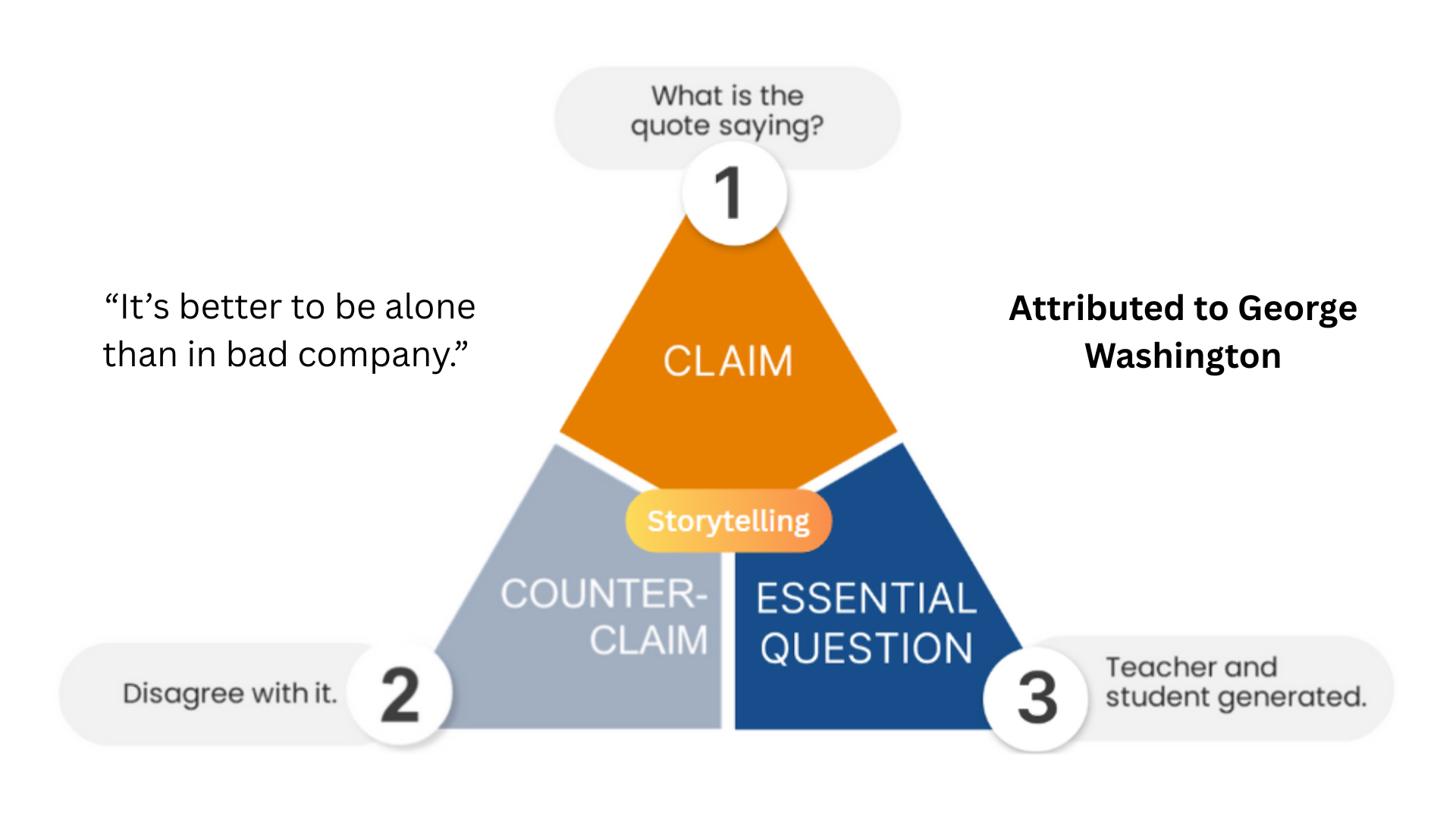
Great teaching has always come down to conversation. Teach Different is built on a single, repeatable structure for classroom dialogue: Claims, Counterclaims, Essential Questions, and Storytelling. This structure maps onto dozens of state, national, and international standards at once.

Because the Method develops critical thinking, inquiry, student voice, and a healthy culture and climate in the same moment, a single conversation can advance literacy, civics, social-emotional, world language, and arts goals together. That is what makes structured conversation the holy grail of standards-based instruction: not one more initiative to layer on, but the through-line that connects nearly everything a school is already required to teach.

How to get started

Three ways to bring Teach Different to your school.

The goal is to help your teachers master the art and science of classroom conversation. There are three ways to get there, and they work at any pace, in any order, with no long-term commitment required to begin.

1

Training

A workshop for your whole department or faculty

A live Teach Different Method™ training brings every teacher through the same structured experience. They see the method modeled, practice it, and leave with a routine they can use the next day.

Format: 90-Minute, half-day or full-day · On-site or virtual · CPDU eligible

Community

2

A worldwide professional learning community

The Teach Different Community keeps teachers connected to the method year-round. A new conversation plan every month, monthly live refresher trainings, and a peer forum for sharing what works.
What’s included: 140+ conversation plans · Monthly live trainings · Best Practice Exchange

Pathway

3

Certification and formal credit

The Certificate Program builds mastery through three mentor-supported cycles of plan, teach, and reflect. Teachers earn documented professional growth and formal credentials toward career advancement.

Credit options: Up to 15 Illinois CPDUs · Graduate credit through Quincy University

These three options work independently or in combination. Contact us to find the right fit for your school.

Reach & Outcomes

What 985 students reported.

In the 2025-2026 cohorts, 80 educators trained in the Teach Different Method™ and implemented the conversation routine with their students. 43 became certified. We surveyed 985 of the students they reached.

80

Educators
Trained

43

Certified
Graduates

4,000+

Students
Reached

985

Student Surveys
Collected

78%

better understood different perspectives

74%

looked at ideas in different ways

65%

felt safe sharing thoughts in class

58%

kept interested in class or school

See it in action

The pilot that produced these outcomes.

The Method

What teachers do.

A structured discussion routine. Four moves.

01

Claim

Begin with a line worth examining. A quote, a proposition, a passage.

02

Counter-Claim

Hold the opposite seriously. Argue the other side, even if it isn’t yours.

03

Essential Question

Frame the tension as a question students can think with.

04

Storytelling

Students bring stories from their own lives. Where the question shows up for them.

What Teachers Are Saying

What teachers are saying.

Since Covid, I felt like I was losing my fastball when it came to getting kids to engage and participate. This program sparked a strategy in class. Getting kids to talk. Getting kids to be engaged.

Mr. Florczyak

Social Studies Teacher

Freeburg Community High School

Freeburg, Illinois

Fall 2025 Graduate

If you want to see what your kids are capable of, get into this program. I had so many moments where I heard kids speak who are almost never willing to volunteer.

Mrs. Massing

Social Studies Teacher

Grayslake Central High School
Grayslake, Illinois

Fall 2025 Graduate

I had so many kids speak up. Kids I hardly ever hear from. My student felt brave enough to say something, and the conversation it sparked from other kids understanding his perspective. That was really cool.

Ms. Thomas

Social Studies Teacher

Alton High School

Alton, Illinois

Fall 2025 Graduate

The Teach Different Method™ is built to land cleanly inside the systems schools and districts already run.

A Tier 1 classroom intervention.

The conversation routine is designed as preventative Tier 1 support for the whole class. Not a pull-out. Not a screened cohort. It builds pro-social behavior and core SEL skills, including empathy, emotional regulation, and perspective-taking, inside regular instruction.

Aligned with ESSA funding.

The training qualifies under ESSA Title I, Part A (professional development that improves teaching, student engagement, and equity) and ESSA Title II (teacher training and leadership development). Districts use these funding streams to bring it in.

Continuing-education credit.

Illinois educators earn 15 CPDU recertification hours upon completion.
For PD directors outside Illinois, the same pattern applies in your state. Your continuing-education framework will use a different name with similar rules. We help you map it.

Graduate credit option.

Available through Quincy University for educators who want further credentialing.

Schedules that fit your year.

Cohorts run Fall, Winter, and Spring. A one-hour live orientation plus an optional 30-minute exit interview. Most coursework is asynchronous and completed during approved PD time or outside school hours, by district policy.

Department or school buyers: the Intro Training and PLC seats are built for departments and individual schools. Certificate Program enrollments work for one teacher or a small group at a building. Districts: the Certificate Program scales to district-wide rollouts with the discounted Peer-Supported tier kicking in once a building has its first certified teacher.

01 · Entry

Teach Different Method Training

A 60-minute Zoom training for up to 15 educators. An introduction to the Teach Different Method and the fastest way for a school to see what it is and decide if it fits.

02 · Ongoing

Online Community Access (PLC)

Year-round access to the Teach Different professional learning community. Monthly live trainings and on-demand replays. Searchable conversation plans. Practitioner-tested tactics from certified teachers. The lowest-friction way for a teacher to begin practicing.

03 · Credentialing

Certificate Pathway

Coach-Supported

Full credentialing in the Teach Different Method™. One-on-one intensive support from a Teach Different coach, with deeper curriculum consultation and facilitation support throughout the program. Pricing discounts available for schools and organizations enrolling 5 or more teachers.

Discounted Path

Certificate Pathway

Self-Paced

The same certification. A good fit for teachers who have a certified peer nearby to support them, or who want more flexibility in how and when they participate.

Upcoming cohorts.

CohortDates
Fall #1, 2026September 23 to December 2, 2026
Fall #2, 2026October 7 to December 16, 2026
Winter, 2027January 22 to April 7, 2027
Spring, 2027March 3 to May 5, 2027
Fall #1, 2027September 22 to December 1, 2027
Fall #2, 2027October 6 to December 15, 2027
Winter, 2028January 19 to April 5, 2028
Spring, 2028March 1 to May 10, 2028

These answers reference Illinois CPDU because that’s where the program is piloted. The same compliance pattern applies in any state. Your continuing-education framework will use a different name with similar rules.

Can a single school or department adopt this on its own?

Yes. The program is built to run at any scale: a few teachers in one building, a whole school, or a coordinated rollout across a district. Many of our early Illinois cohorts came in school-by-school. The Intro Training, PLC seat, and individual Certificate Program enrollments all work cleanly at the building level. We’re happy to provide whatever documentation your business office or district administration needs to approve the purchase or PD time.

The program runs in a PD cycle, not classroom instruction. Teachers complete the learning components during approved PD or work time, or outside school hours, based on district policy. They then apply the conversation routine during regular instruction as part of normal teaching practice.
No. The program can be configured so teachers complete work during approved time. The district may compensate teachers if participation occurs outside contract hours.
Illinois CPDU time covers professional learning activities around implementation: orientation, collaboration, reflection, and curriculum-related preparation. It does not include time spent teaching students or implementing the method live in class.
Because Illinois CPDUs are intended for professional learning, not the act of teaching. This separation helps avoid overlap with compensated instructional duties and keeps the PD hours defensible.
Yes. There is a required one-hour live orientation plus asynchronous work completed outside school hours. Recorded options can make scheduling even easier.
Yes. Many components are asynchronous and can be completed during approved work time if district policy permits. For example: reflection, curriculum planning, and collaboration.

Participation is documented through:

  • Zoom attendance reports for live sessions
  • Submissions and reflections in the online community
  • Confirmations of shadow debrief or check-ins, when used
The program is designed with flexible scenarios in mind. The guardrail is that Illinois CPDU hours only cover professional learning (preparation, reflection, collaboration), while classroom instruction remains standard job responsibility. Districts choose the time window that best aligns with their policies and bargaining agreements.
Minimal. Typically a one-hour orientation (live or recorded) plus an optional 30-minute exit interview, with optional support sessions available as needed.

Conversation is the language of
freedom.

Help your teachers teach it.

At a glance

For

Educators in grades 5 to 12

Format

Live trainings, self-paced modules, and year-round online learning. Options for every schedule and budget.

Approach

A universally designed Tier 1 classroom intervention. Works across subjects, grade levels, and student populations.

Funding eligibility

ESSA Title I, Part A & Title II

Credit

Up to 15 CPDUs (Illinois teachers). Graduate credit option through Quincy University.

Certificate cohorts

Fall, Winter, Spring

Developed with an Illinois Department of Human Services grant, in partnership with the Illinois Institute of Independent Colleges and Universities.

Bring it to your school

Bring it to your school.

Classrooms are where young people learn to think with other people. To hold a position without holding a grudge. To listen as hard as they speak. The Teach Different Method™ trains educators in a routine that makes that practice possible, week after week, in any subject.

It’s the most human thing classrooms still do.

Conversation is the language of freedom.

Help your teachers teach it.